Textile processing today is being evaluated on far more than colour output alone. Mills are expected to achieve consistent shade reproduction, shorter processing cycles, lower water consumption, compliance with global sustainability standards, and improved fabric performance, all while maintaining cost efficiency at scale.
This shift has made textile auxiliaries one of the most critical components in modern wet processing.
Dyeing performance is no longer determined only by dyes or machinery. The efficiency of the entire process increasingly depends on the supporting chemistry used throughout preparation, dyeing, washing, fixation, and finishing. The right dyeing influences exhaustion rates, dispersibility, foam control, migration behaviour, pH stability, and process optimisation across different fibre types and dye classes.
At Neochem, we have seen a clear transition in the industry over the last decade. Textile manufacturers are moving away from fragmented chemical sourcing toward integrated auxiliary systems that improve productivity while supporting sustainability goals.
Whether the requirement is lower bath ratios, faster processing, reduced reprocessing, or bio-based chemistry, auxiliaries now directly impact operational profitability.
This guide explains the major types of dyeing auxiliaries, their industrial functions, and how textile processors can select the right solutions for better process stability, resource efficiency, and long-term manufacturing performance from a leading dyeing auxiliary manufacturer India.
Understanding Textile Auxiliaries in Dyeing Operations
Textile auxiliaries are specialty performance chemicals used to support and optimise textile processing operations. In dyeing, these chemicals help improve dye-fibre interaction, process control, machine efficiency, final fabric quality, and anti-creasing agent dyeing performance during high-temperature processing.
Unlike dyes, auxiliaries do not primarily add colour. Their role is to create the right processing environment for consistent and efficient dyeing.
In textile wet processing, auxiliaries influence:
- Dye penetration and exhaustion
- Wetting and absorbency
- Dispersion stability
- Foam management
- pH control
- Shade uniformity
- Fastness properties
- Washing efficiency
- Process time reduction
- Water and energy consumption
Modern textile manufacturing relies heavily on process consistency. Even high-quality dyes can deliver inconsistent results if auxiliaries are not correctly selected or balanced.
Beyond process support, auxiliaries today directly influence mill-level productivity, sustainability performance, and operational stability. In high-volume textile manufacturing, even small improvements in dye exhaustion, washing efficiency, foam control, or cycle reduction can create measurable impact on water usage, steam consumption, machine productivity, and reprocessing costs.
This is why integrated auxiliary systems are increasingly replacing fragmented chemical sourcing models. Textile processors are looking for chemistry platforms that work together across pretreatment, dyeing, washing, and finishing rather than isolated single-function products.
At Neochem, our dyeing auxiliary development focuses on process compatibility, multifunctional efficiency, and application-specific performance across modern textile manufacturing environments.
Major Types of Dyeing Auxiliaries and Their Functions
Different stages of dyeing require different categories of auxiliaries. Each chemical performs a specific technical role within the process.
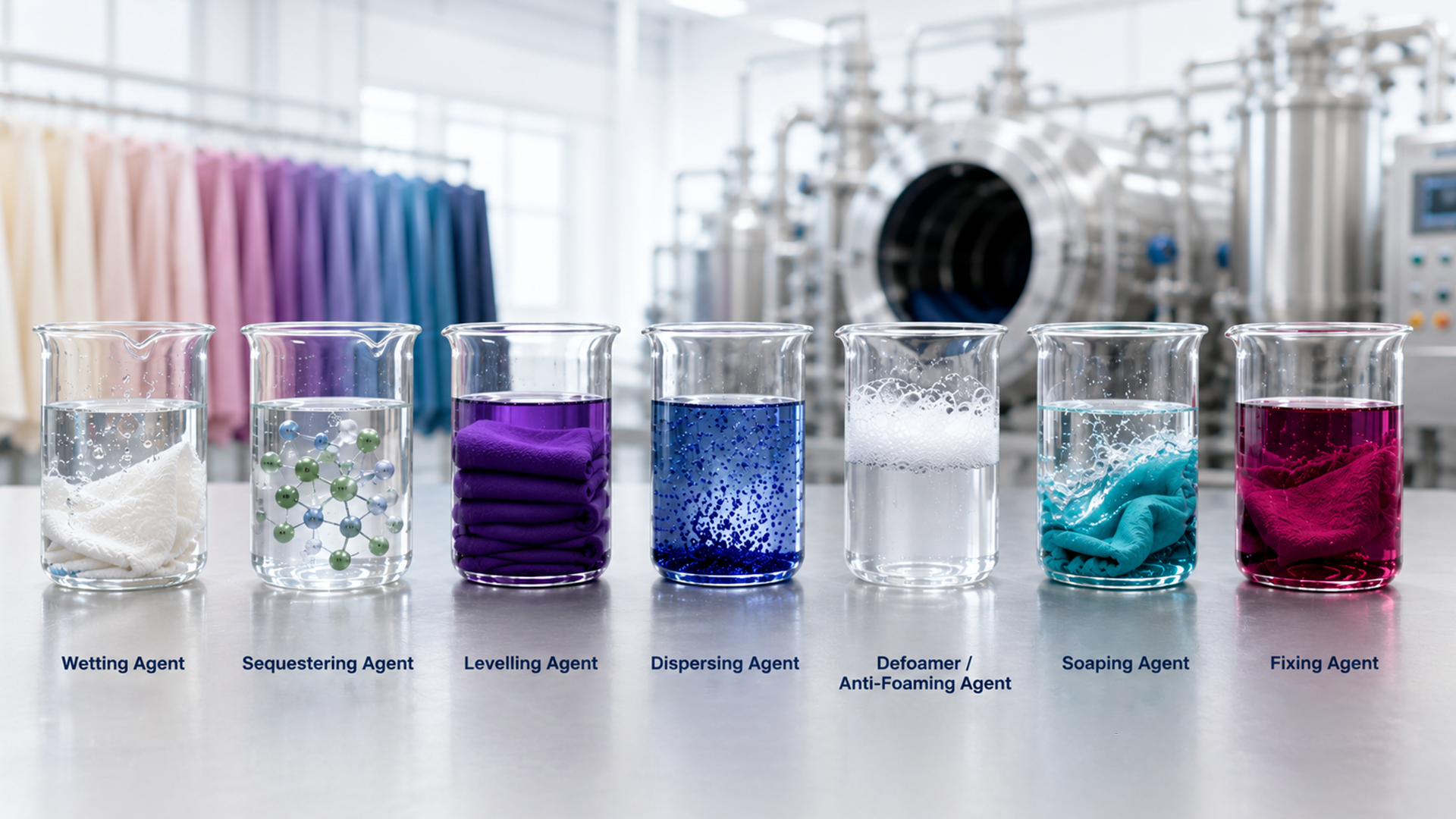
1. Wetting Agents
Wetting agents reduce surface tension and allow processing liquor to penetrate fibres quickly and uniformly.
They are especially important in:
- Cotton pretreatment
- Desizing and scouring
- High-speed dyeing operations
- Low liquor ratio systems
Poor wetting can create uneven absorbency, resulting in patchy dye uptake and shade variation.
Modern wetting agents are expected to provide:
- Rapid penetration
- Low foam generation
- Alkali stability
- Compatibility with multiple dye systems
At Neochem, the Klaritol range is developed to support efficient and stable textile processing. Products like Klaritol Pro 8700 are high-performance low-foaming wetting cum scouring agents specially designed for Soft Flow and Jet applications on cotton, synthetic fabrics, and blends.
The formulation helps improve pretreatment efficiency while supporting better absorbency consistency, lower foam generation, and smoother processing performance across textile operations.
2. Sequestering Agents
Water hardness remains one of the most overlooked factors affecting dyeing quality.
Calcium and magnesium ions present in water can interfere with dyes and auxiliary performance, leading to:
- Precipitation issues
- Reduced dye fixation
- Machine deposits
- Uneven shades
Sequestering agent dyeing applications help bind metal ions and maintain bath stability throughout processing.
Advanced plant-origin sequestrants are now gaining importance because they help mills meet sustainability targets while reducing phosphate-heavy chemical usage.
Our sustainable chemistry initiatives include bio-based sequestrant systems developed to support environmentally responsible textile manufacturing.
Neochem’s QUNOX range is designed to provide effective sequestration and chelation performance across textile wet processing operations, helping maintain bath stability and prevent metal ion interference during dyeing and bleaching.
Key solutions include:
- Qunox ULTIMA Liquid: Special sequestering cum chelating agent for preventing catalytic damage caused by Iron during Bleaching.
- Qunox EMG: Sequestering cum chelating agent for continuous and discontinuous applications.
- Qunox BA: Cost effective Sequestering cum chelating agent for discontinuous applications.
These solutions help control the adverse effects of calcium, magnesium, and iron ions, supporting improved dye fixation, reduced machine deposits, and enhanced process consistency across textile processing operations.
3. Levelling Agents
Levelling agents control dye uptake rates to ensure uniform colour distribution across the fabric.
They are critical in:
- Polyester dyeing
- Nylon dyeing
- Reactive dye systems
- Dark shade processing
Without proper levelling support, rapid dye exhaustion can result in:
- Barre marks
- Patchiness
- Unlevel shades
- Reprocessing losses
A well-designed leveling agent dyeing system improves migration behaviour and allows dyes to redistribute evenly before fixation occurs.
From an operational perspective, this reduces shade correction requirements and improves first-time-right production rates.
Neochem’s EVENOL range is designed to support controlled dye migration and improved shade uniformity across reactive and polyester dyeing systems.
Products such as Evenol DLR Plus are widely used as high-performance levelling agents for reactive dyeing on cellulosic fibres and blends, helping processors improve first-time-right dyeing performance while reducing shade correction requirements.
4. Dispersing Agents
Dispersing agents keep insoluble dye particles evenly suspended throughout the dye bath.
They are widely used in:
- Polyester dyeing
- Disperse dye applications
- High-temperature dyeing systems
Inadequate dispersion can create:
- Dye agglomeration
- Specks and spots
- Filtration problems
- Machine deposits
Modern dispersing agents must also withstand high temperatures and pressure conditions while maintaining bath stability.
At Neochem, dispersing agent dyeing solutions are developed by balancing high dispersion efficiency with reduced residue formation and cleaner machine performance.
Within Neochem’s portfolio, Evenol LDA functions as a versatile dye bath conditioner and dispersing solution for reactive dyeing and printing applications. It also supports oligomer control in polyester dyeing and improves machine cleanliness, helping mills maintain stable processing conditions with reduced residue formation.
5. Defoamers and Anti-Foaming Agents
Foam generation can significantly reduce processing efficiency in modern high-speed textile machines.
Excess foam affects:
- Pump circulation
- Bath consistency
- Machine productivity
- Chemical dosing accuracy
In continuous and jet dyeing systems, uncontrolled foam often results in operational interruptions and uneven processing.
Effective defoamers should provide:
- Fast foam knockdown
- Long-lasting control
- Process compatibility
- Minimal residue
Foam inhibitor jet dyeing chemistry is commonly selected based on machine conditions and application requirements.
Neochem’s KOLAPSOL range is developed for high-turbulence and high-temperature dyeing systems where foam control directly affects machine efficiency. Products like Kolapsol ST and Kolapsol AFD help maintain bath stability in jet and package dyeing machines while reducing interruptions caused by uncontrolled foam generation.
6. Soaping Agents
After dye fixation, unfixed dye molecules must be removed from the fabric surface to improve wash fastness and rubbing fastness.
Soaping agents help:
- Remove hydrolysed dyes
- Improve colour clarity
- Enhance fastness performance
- Reduce back staining
This stage becomes particularly important in reactive dyeing processes where incomplete washing can impact garment performance later in the value chain.
Efficient washing off agent reactive systems also contribute to lower rinsing requirements and reduced water consumption.
Neochem’s AMPINOL range supports efficient washing-off performance in blended fabric processing. Solutions such as Ampinol RDP and Ampinol RDP-CW are developed for single-bath washing off applications in polyester/cotton and polyester/viscose blends, helping mills improve washing efficiency while reducing processing time and water consumption.
7. Fixing Agents
Fixing agents improve dye fixation and fastness properties after dyeing.
They are commonly used in:
- Reactive dyeing
- Direct dye applications
- Garment dyeing
Modern fixing systems are evolving toward formaldehyde-free chemistry to support international compliance standards and safer textile production.
At Neochem, sustainability-led development includes low-impact dye fixative textile solutions aligned with global textile compliance expectations including ZDHC-focused manufacturing practices.
The DYFAST range at Neochem includes advanced dye fixative technologies developed for reactive and direct dyeing applications on cotton and blended fabrics.
Products such as Dyfast DTF Plus and Dyfast PMD Plus are designed to improve fastness performance while maintaining minimal tonal variation, supporting both export-quality processing and compliance-focused textile manufacturing.
How Dyeing Auxiliaries Improve Textile Efficiency
Textile processors today are under pressure to improve both production output and environmental performance simultaneously.
The right auxiliary combination directly supports this balance.
Reduced Processing Time
Advanced auxiliary systems can shorten:
- Scouring cycles
- Dyeing duration
- Washing sequences
In many mills, reducing even 15–20 minutes per batch creates significant annual production gains. Some modern multifunctional auxiliaries also combine multiple processing actions into a single chemistry platform, reducing chemical inventory and dosing complexity.
Lower Water Consumption
Water reduction is now a major operational priority across textile processing.
Optimised auxiliaries contribute through:
- Lower bath ratios
- Reduced rinsing stages
- Faster washing-off
- Improved wetting efficiency
At Neochem, our sustainable textile chemistry initiatives are increasingly focused on auxiliaries that help mills reduce water usage without compromising dyeing quality.
Energy Savings
Shorter cycles and lower processing temperatures directly reduce steam and energy consumption.
Energy-efficient auxiliaries support:
- Faster heating penetration
- Improved process stability
- Reduced reprocessing
For textile manufacturers operating continuously at scale, these reductions create measurable operational savings.
Improved Shade Consistency
One of the largest hidden costs in textile processing is reprocessing caused by shade variation.
Well-designed auxiliary systems help maintain:
- Dye bath stability
- Uniform dye migration
- Controlled exhaustion behaviour
This improves right-first-time production and reduces wastage across the dyeing floor.
Selection Guide: Choosing the Right Dyeing Auxiliaries
Selecting auxiliaries should go beyond basic product compatibility. The chemistry must align with processing conditions, sustainability goals, machine configuration, and end-product requirements.
At Neochem, we generally evaluate auxiliary selection through a process-performance approach rather than only a chemical-cost approach.
The selection process also includes evaluating processing stability factors such as acid neutralizer textile compatibility and maintaining an effective pH buffer dye bath environment for consistent dyeing performance.
1. Fibre and Dye Compatibility
Different fibres require different auxiliary behaviours.
For example:
- Cotton processing requires strong wetting and washing performance
- Polyester dyeing demands high-temperature dispersion stability
- Blended fabrics require balanced multifunctional chemistry
Compatibility between auxiliaries and dye classes remains essential for process reliability.
2. Machine Type and Processing Method
Jet dyeing, soft flow systems, continuous ranges, and garment dyeing all require different chemical performance characteristics.
Factors such as:
- Liquor ratio
- Shear conditions
- Temperature profile
- Circulation speed
directly influence auxiliary selection.
A product performing well in one system may not deliver the same efficiency in another.
3. Sustainability and Compliance Requirements
Global textile brands increasingly demand compliance with sustainability standards including:
- ZDHC
- GOTS
- Restricted substance regulations
This has accelerated the transition toward:
- Bio-based chemistry
- Formaldehyde-free systems
- Low-VOC auxiliaries
- Biodegradable formulations
Neochem continues investing in green chemistry platforms that help textile manufacturers meet evolving global compliance requirements while improving process efficiency.
4. Process Optimisation Potential
The best auxiliary systems do more than solve a single problem.
They should also contribute toward:
- Lower inventory dependency
- Fewer processing stages
- Reduced dosing complexity
- Higher machine productivity
Many textile processors today are moving toward consolidated chemical systems that improve operational simplicity and scalability.
Neochem’s Approach to Textile Auxiliaries
At Neochem, textile auxiliaries are developed with a strong focus on application performance, sustainability, and process optimisation.
Our dyeing auxiliary portfolio includes specialised solution platforms such as:
- EVENOL: Leveling & dispersing agents and alkali donor systems
- AMPINOL: Washing-off agents and protective colloids
- DYFAST: Dye fixative agents
- KOLAPSOL: Foam inhibition agents
These product systems are developed to support modern textile mills operating under increasing pressure for shorter processing cycles, lower water consumption, improved fastness performance, and compliance-ready manufacturing.
What differentiates modern auxiliary development is no longer only chemistry performance in isolation. It is the ability to improve the overall efficiency of textile manufacturing.
Our development approach focuses on:
- Lower water and energy consumption
- Improved process consistency
- Reduced cycle times
- Sustainable raw material integration
- Compliance-ready formulations
- Technical application support
As textile manufacturing evolves toward cleaner and smarter production systems, auxiliaries will continue playing a larger role in operational efficiency and sustainability performance.
Conclusion
Dyeing auxiliaries have become central to modern textile processing efficiency. Their impact extends beyond dye application into productivity, sustainability, resource optimisation, and process reliability.
For textile manufacturers, selecting the right textile auxiliaries is no longer simply a procurement decision. It directly influences production consistency, operational cost, compliance readiness, and long-term manufacturing competitiveness.
At Neochem, we continue building auxiliary solutions that combine technical performance with responsible chemistry. From bio-based innovations to process-efficient formulations, our focus remains on enabling textile manufacturers to achieve better output with smarter and more sustainable processing systems.
In an industry where efficiency and environmental responsibility are becoming equally important, the future of textile processing will increasingly depend on how intelligently auxiliaries are selected, integrated, and optimised across the value chain.